
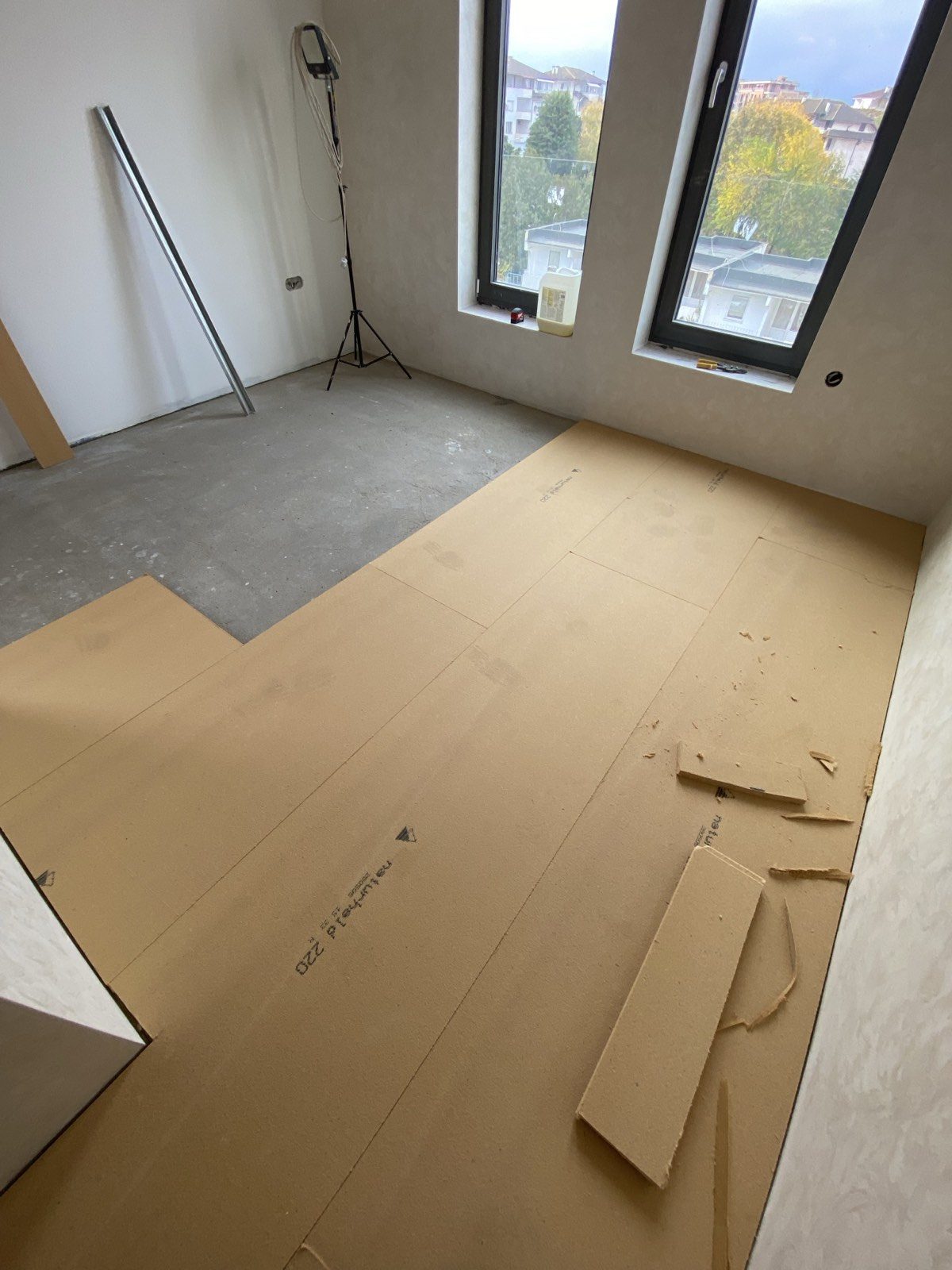
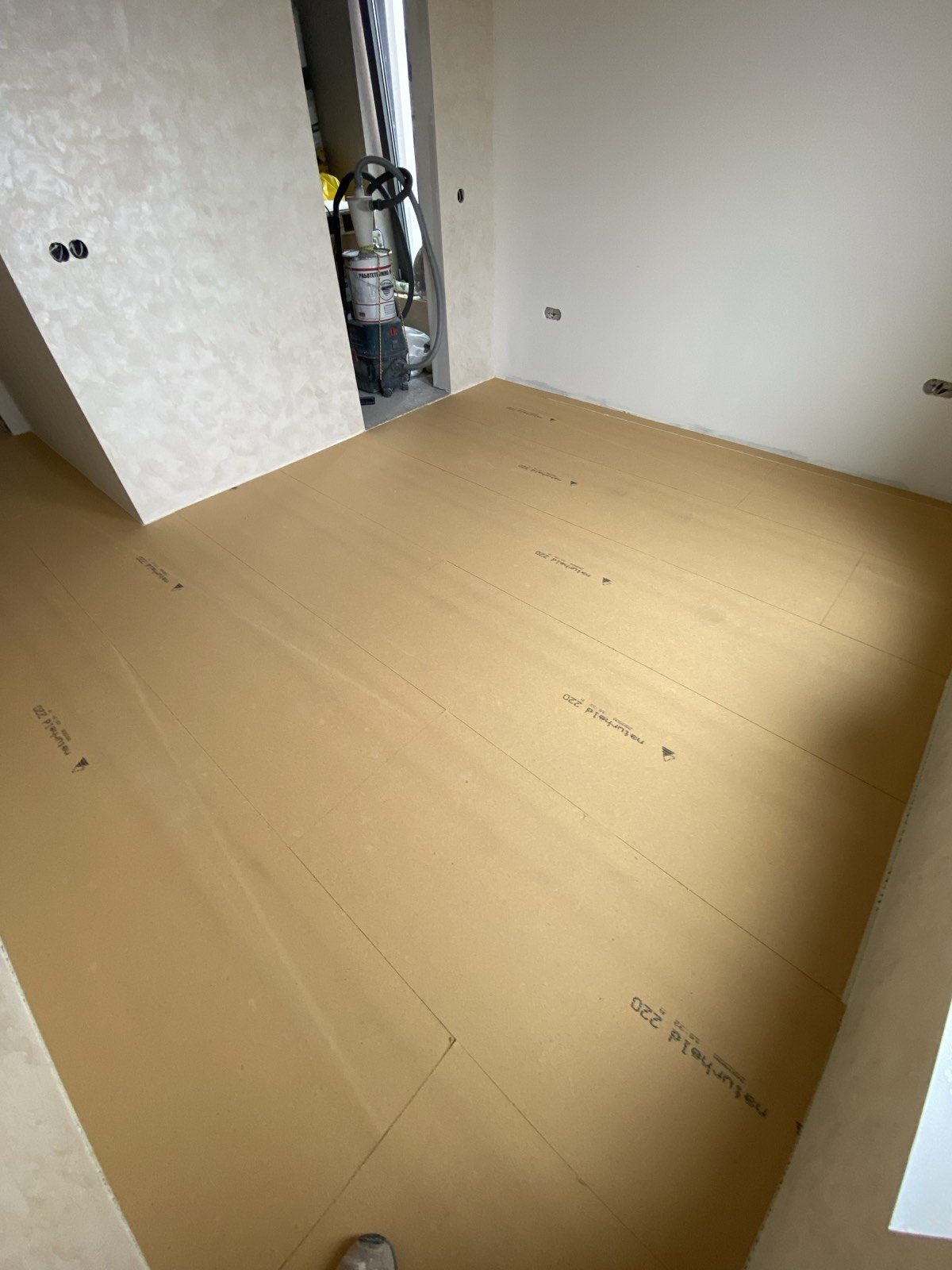
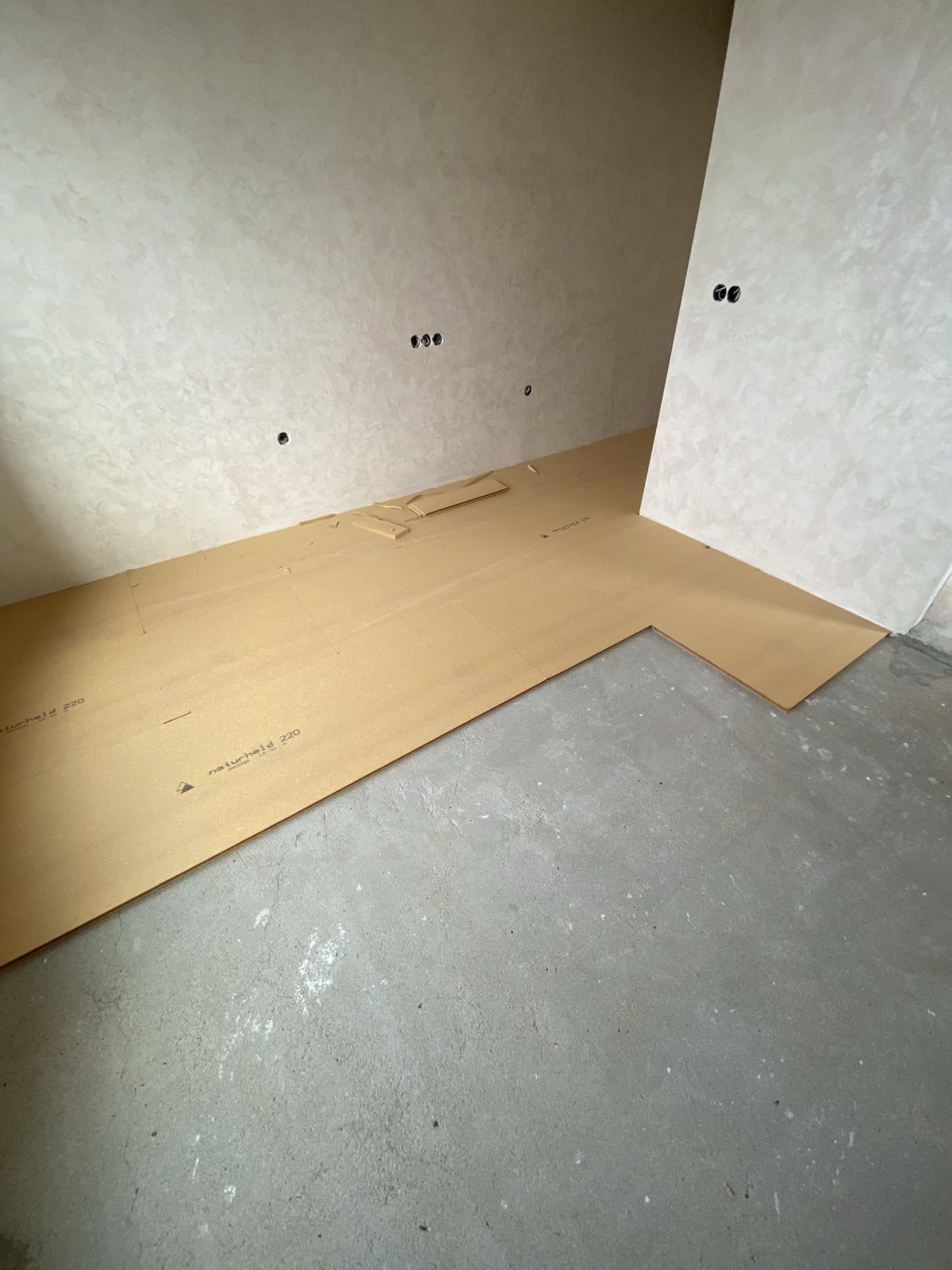
In a flat in Burgas the floor is built dry: 22 mm naturheld 220 wood fibre boards are laid on the concrete screed. Floating floors such as laminate, floorboards or 19 mm ELKA VITA tongue-and-groove boards can be installed directly on them.
Floating floors such as cork, SPC, laminate or click parquet are laid directly on the boards, with no other underlay. For tiles or any other glued floor covering, consult us about the specific product — most often a gypsum fibre board is laid on the boards as a rigid base to glue onto.
What the board does under the floor
- Less noise for the neighbours. The boards separate the floor covering from the concrete. Footsteps, moved chairs and dropped objects travel less to the flat below, and the floor does not sound hollow as it does on thin foil.
- Takes up unevenness. A screed is rarely perfectly flat. The board is soft enough to absorb small bumps and dips of a few millimetres and stiff enough to stay flat under the floor covering. The floor does not rock and click joints do not break.
- A warmer floor. With λ = 0.047 W/(mK), a 22 mm board adds about 0.47 m²K/W of thermal resistance. The floor feels warmer than one laid straight on concrete.
- Dry, fast and light. No wet screed and no weeks of waiting. A 22 mm board weighs about 5 kg/m². For comparison, 5 cm of cement screed is about 100 kg/m².
- Strong. Compressive stress at 10% deformation is at least 200 kPa. Furniture, people and tiles do not crush it.
The layers with a floating floor
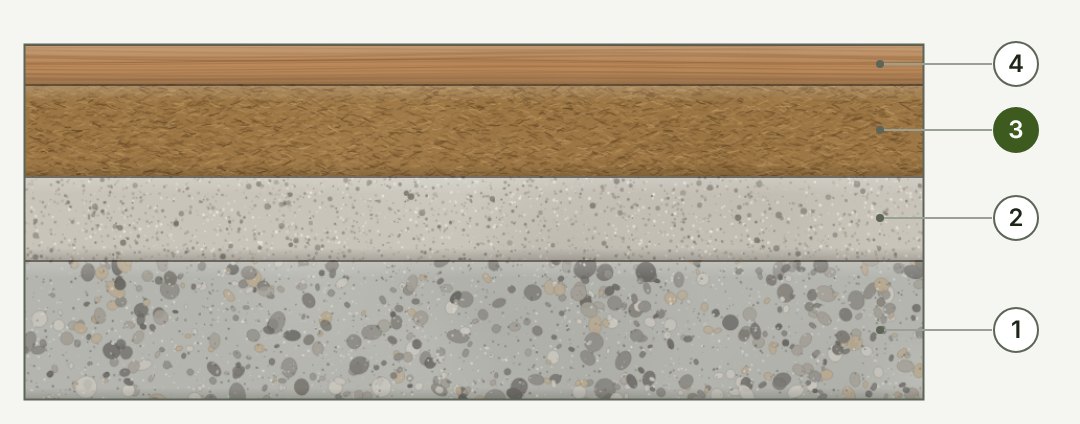
- Reinforced concrete slab
- Cement screed
- naturheld 220, 22 mm — wood fibre underlay
- Floating floor — cork, SPC, laminate or click parquet, floating floorboards or ELKA VITA 19 mm
Directly on naturheld 220 you lay cork, SPC, laminate or click parquet, floating floorboards or 19 mm ELKA VITA tongue-and-groove boards — with no other underlay at all. VITA is a three-layer solid wood board — it is both the base and a finished timber floor. The floor is about 30–45 mm high.
If you do not want a cement screed
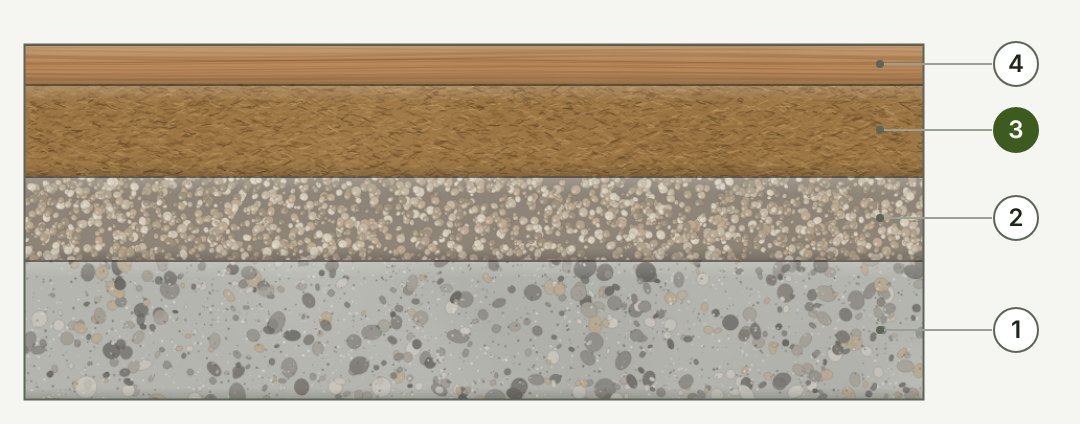
- Reinforced concrete slab
- Dry loose-fill screed
- naturheld 220, 22 mm — wood fibre underlay
- Floating floor — cork, SPC, laminate or click parquet, floating floorboards or ELKA VITA 19 mm
Instead of a cement screed, a dry loose-fill screed — a levelling fill — is poured onto the slab. It is spread, levelled with screed rails and compacted as its manufacturer specifies, and the naturheld 220 boards are laid straight on top. There is no wet work and no waiting for a screed to dry.
The layers with tiles and glued floors
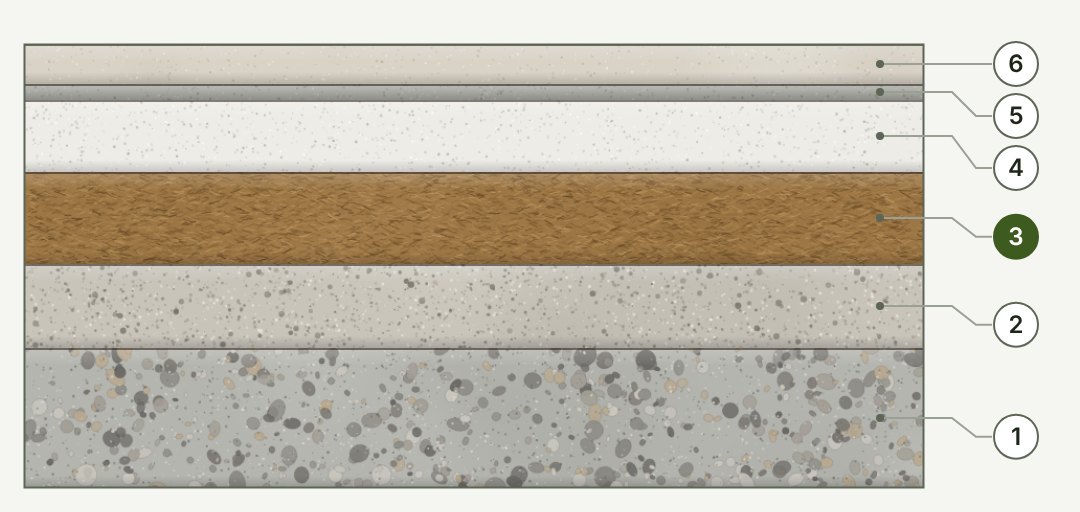
- Reinforced concrete slab
- Cement screed
- naturheld 220, 22 mm — wood fibre underlay
- Gypsum fibre board — rigid base to glue onto
- Adhesive
- Tiles or another glued floor covering
For glued floor coverings, consult us about the specific product. Most often a gypsum fibre board is laid on the boards — it takes the load and spreads it over the wood fibre. The total floor height with tiles is about 50–55 mm.
How it is laid
- Check the screed. It must be dry, sound and clean. Sharp bumps are knocked off. Slopes or hollows of more than a few millimetres are levelled before the boards — with self-levelling compound or dry fill.
- Film if needed. On a new screed, or under laminate and parquet, lay 0.2 mm PE film with overlaps. It protects the wood from residual moisture in the concrete.
- Edge strip. Fit an edge strip of about 10 mm around the room — an Isocell strip or the standard strip used for floors. The floor must not touch the walls — otherwise noise travels through them.
- The naturheld 220 boards. Lay them loose, tongue into groove, with staggered end joints (at least 20–30 cm). Do not glue or screw them to the screed. The offcut from the end of one row starts the next.
- The floor covering. Tiles on primed gypsum fibre with flexible adhesive; in bathrooms with waterproofing from the manufacturer’s system. Cork, SPC, laminate, click parquet, floating floorboards and ELKA VITA are laid floating directly on naturheld 220, as the floor manufacturer specifies.
Quantities and price
| naturheld 220, 22 mm | Edge | €/m² incl. VAT | Boards / m² per pallet |
|---|---|---|---|
| 2550 × 615 mm | tongue and groove | €13.03 | 104 / 163.1 m² |
Add 5–8% for offcuts.
Work out the quantity for your rooms in the calculator.
Who will install it? Your builder. The boards are cut with a saw and laid without glue — we give them the manufacturer’s instructions and help over the phone. No builder yet? Write to us and we will help.
Questions
What can be laid directly on naturheld 220?
Floating floors — cork, SPC, laminate or click parquet, floating floorboards or 19 mm ELKA VITA tongue-and-groove boards — with no other underlay at all. On a mineral base, 0.2 mm PE film goes under the boards.
Is gypsum fibre board needed under tiles?
For tiles and other glued floor coverings, consult us about the specific product. Most often a gypsum fibre board is laid on naturheld 220 as a rigid base to glue onto.
Are the boards glued to the screed?
No. They are laid loose, with staggered joints and an edge strip at the walls. The floor stays floating, so noise does not pass into the concrete and walls.
What unevenness does the board take up?
Small bumps and dips of a few millimetres. Larger slopes or holes are levelled before laying.
How high does the floor become?
With laminate, SPC or cork about 30–35 mm. With 19 mm ELKA VITA about 41 mm. With gypsum fibre and tiles about 50–55 mm.